If your commercial air conditioning keeps breaking down, the issue is rarely random – and it is almost never a case of ‘bad luck.’ In most commercial buildings, repeated air conditioning failures are a symptom of an underlying problem that hasn’t been diagnosed or resolved properly.
For facility managers, property managers and building owners, recurring breakdowns create more than an uncomfortable working environment. They lead to tenant or customer complaints, lost productivity, reputational pressure and escalating maintenance expenses. Each emergency callout feels urgent, each temporary repair feels reactive and over time, confidence in your system begins to erode.
In Western Australia, where summer temperatures regularly push systems to their limits, commercial HVAC equipment operates under continual stress. That being said, climate alone is not the primary reason that systems fail repeatedly. In our experience across commercial properties, frequent breakdowns almost always trace back to identifiable and preventable causes – and understanding those causes is the first step in breaking the cycle.
The 7 Most Common Reasons Commercial AC Systems Fail Repeatedly
When a commercial AC breakdown occurs more than once, the focus should immediately shift from fixing the fault to finding the root cause. Without proper investigation, buildings often fall into a pattern of reactive repairs that treat surface-level symptoms, instead of solving the real underlying issue.
Lack of Preventative Maintenance
The single most common reason a commercial air conditioning system keeps breaking down is insufficient preventative maintenance. Commercial systems are complex mechanical assets that rely on clean airflow, stable electrical connections, correct refrigerant charge and well-maintained components to operate efficiently. Over time, condenser coils accumulate dirt, belts loosen, electrical terminals degrade, filters accumulate dirt and minor refrigerant leaks escalate.
In isolation, these issues may appear minor. But collectively, they place significant strain on the system. Compressors overheat, fans work harder than designed and electrical components begin to fail prematurely. What begins as a small maintenance oversight generally ends in a costly commercial air conditioning breakdown during a period of peak demand.
Many facilities adopt a ‘run to failure’ approach due to budget pressure. However, emergency repairs are almost always more expensive than structured preventative maintenance programs. Planned servicing provides predictable costs and ensures asset life is extended. Reactive callouts create uncertainty and compounding damage.
Poor Initial Installation or System Design
Repeated breakdowns can sometimes be traced back to decisions made years earlier during installation. If a commercial system was incorrectly sized, poorly balanced or installed without proper commissioning, ongoing performance issues are inevitable.
Undersized systems struggle to meet cooling demand and as such operate continuously. An oversized system will short-cycle, turning on and off frequently which increases wear on compressors and electrical components. Poor duct design can restrict airflow, causing uneven temperatures and stress to the system. Incorrect control setups can lead to inconsistent operation and unnecessary load spikes.
These design flaws may not become obvious until the system ages or faces extreme seasonal demand. When breakdowns occur in this scenario, replacing individual components does not resolve the core issue. Proper engineering assessment is required to identify whether the root cause lies in system design rather than component failure.
Electrical & Control Faults
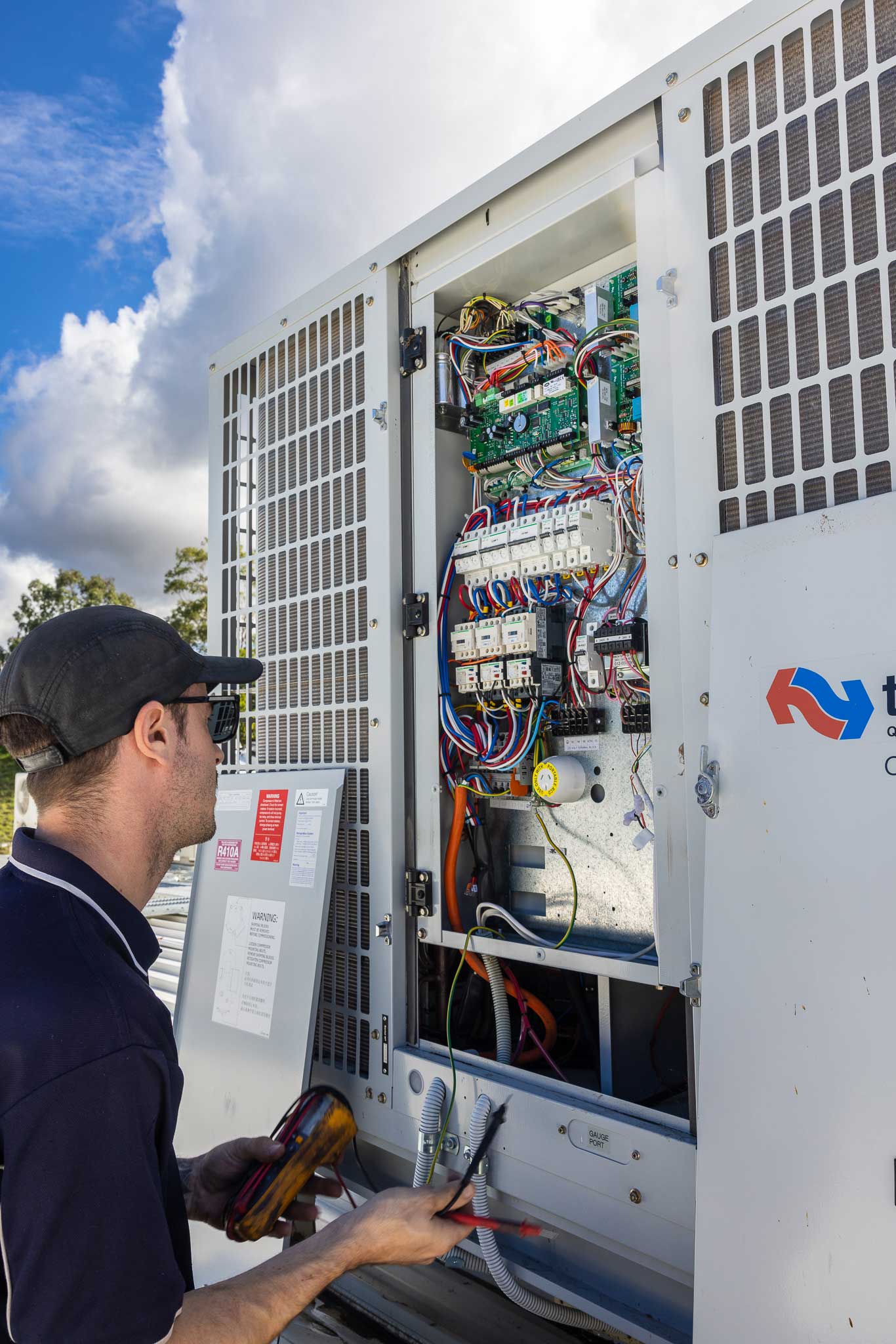
Electrical and control issues are among the most misdiagnosed causes of HVAC system frequent breakdowns. Commercial systems rely heavily on sensors, relays, contactors, printed circuit boards and building management system (BMS) integration. When any of these elements begin to fail, the symptoms can be intermittent and misleading.
A failing contactor may cause the unit to shut down unexpectedly. A faulty temperature sensor can cause erratic operation. Voltage instability may trip protective devices under load. In some cases, simply resetting the system temporarily restores function, leading to the assumption that the issue has resolved itself.
In reality, electrical faults tend to worsen over time. Without thorough testing under load conditions by an experienced contractor, these issues can continue to trigger breakdown events that appear unpredictable but are entirely traceable.
Refrigerant Leaks That Were Never Properly Located
One of the clearest indicators that a commercial AC system is being treated symptomatically rather than strategically is repeated refrigerant top-ups. If the system works for several months after a recharge and then fails again, the underlying leak has not been identified and repaired properly.
Refrigerant leaks reduce cooling capacity and force compressors to operate under strain. Over time, low refrigerant conditions lead to overheating and potential compressor damage. This is often one of the most expensive failures that commercial HVAC systems experience. Beyond mechanical risk, refrigerant management carries environmental and compliance obligations.
Continual top ups may appear cost-effective in the short term, but it significantly increases long-term risk. Proper leak detection and repair is key to preventing repeated breakdown cycles.
Ageing Equipment Near End of Life
All commercial air conditioning systems have a finite lifespan. Rooftop packaged units typically operate effectively for 12 to 15 years, VRF systems for 10 to 15 years and well-maintained chillers can exceed 20 years. As systems approach the end of their useful life, component failure frequency increases.
Repeated compressor issues, increased energy consumption, hard to source replacement components and multiple breakdowns within a single year are strong indicators that the asset may be nearing replacement stage. At this point, continuing with repair and maintenance schedules may provide diminishing returns.
This does not mean immediate replacement is always required. However, lifecycle data and performance trends should inform decision making. When a commercial AC breakdown becomes a recurring event on ageing equipment, it is often a sign of broader asset fatigue.
Overworked Systems During WA Summers
Perth’s summer conditions place exceptional demand on commercial HVAC systems, particularly rooftop units exposed to high ambient temperatures. When condenser coils are dirty or airflow is restricted, the system’s ability to reject heat declines sharply.
Under extreme heat load, marginal systems fail first. Electrical components overheat, compressors trip on safety controls and units shut down under pressure conditions. In many cases, the breakdown itself is simply the final trigger of a system that has been operating under stress for an extended period.
Pre-summer inspections and servicing significantly reduce the likelihood of peak-season commercial air conditioning repair emergencies.
The Wrong Contractor Diagnosing the Issue
In some cases, the reason a commercial air conditioning system continues to break down is not mechanical – it is diagnostic. When contractors default to replacing large components without thorough fault finding, buildings can enter a costly cycle of unnecessary part swaps and recurring issues.
Accurate diagnosis requires technical expertise, methodical testing and a willingness to investigate beyond the obvious. Not every failure requires the replacement of a major component. Sometimes a relatively small control fault or electrical component is the true cause. Without a diagnostic-first approach, breakdown patterns repeat and costs escalate.
How to Stop the Cycle of Repeated Breakdowns
Breaking the pattern of commercial AC breakdown requires structured evaluation rather than reactive repairs. The first step should be a comprehensive system condition assessment, reviewing equipment age, maintenance history, previous fault reports and trends in performance.
Maintenance records can often reveal recurring issues that have been temporarily resolved but never fully addressed. Asset lifecycle data provides clarity around whether continued repair is economically sound. From there, implementing a structured preventative HVAC maintenance program ensures minor issues are identified before they escalate into failures.
Equally important is working with a contractor capable of making timely decisions and taking ownership of outcomes. Delayed approvals and fragmented responsibility often lead to prolonged issues. Clear communication and accountability significantly improve reliability. When these measures are implemented properly, most facilities see a noticeable reduction in repeat breakdowns within the first year.
When Is It Time to Replace Instead of Repair?
While repair is often an appropriate solution, there are circumstances where replacement provides better value long term. A commonly used guideline is the 50 percent rule: if a single repair exceeds 50 percent of the replacement cost, upgrading the system warrants serious consideration.
Repeated compressor failures, major refrigerant leaks in ageing systems, obsolete controls and consistently high energy consumption are strong indicators that replacement may deliver greater reliability and efficiency. Modern systems often provide improved energy performance, reducing operational costs over time.
Importantly, replacement decisions should be based on data and lifecycle cost analysis – not pressure. Strategic planning avoids rushed decisions during emergency breakdown scenarios.
How Complete Refrigeration & Air Approaches Chronic Breakdown Issues
When addressing recurring commercial air conditioning breakdown problems, our focus is on structured diagnostics and long-term reliability. Rather than responding to the faults in isolation, we review system history, operating conditions and asset lifecycle, taking a data-driven approach to identifying the true cause.
Our round-the-clock field service capability across the Perth and Peel regions ensures urgent issues are attended to in a timely fashion, but we’re cognisant that response speed is only part of the solution. Through asset management and documented maintenance records, we provide building owners and facility managers with clarity around performance trends and future planning.
Honest repair advice, clear communication and direct access to our management team form a core part of our approach. The objective is always to stabilise the asset, reduce repeat failures and protect your long-term operational budget.
Conclusion: Fix the Cause — Not Just the Symptom
If your commercial air conditioning system continually breaks down, the solution is not another temporary repair. It is a structured, data-driven assessment of why the failure continues to occur.
Most recurring breakdowns are predictable. Most are preventable – and when diagnosed correctly, they can be resolved without unnecessary cost escalation.
For facility managers and building owners, the priority should always be reliability over stop-gap fixes. Addressing the root cause restores confidence in your HVAC system, protects comfort and reduces financial uncertainty.
If your site is experiencing ongoing commercial AC breakdown issues in Perth, the next step is not another reset. It is a comprehensive system review from the specialists at Complete Refrigeration & Air.
Get in touch to book a commercial HVAC system assessment or speak directly with our service team to discuss your facility’s requirements.